Manga Mania: Just Okay

>> Friday, March 11, 2011

Contest!
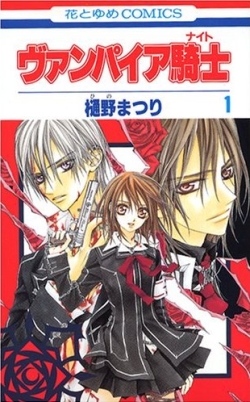
First, something I never ever do, I'm going to do. That's right, a contest! And it's a retroactive contest. See, during my manga mania, I picked up several books that I either already had or turned out didn't work out for me, including several first in a series: Otomen, Kimi ni todoke, Ratsetsu, Bride of the Water God, and Vampire Knight. I also have volume 20 (don't ask me why) of Fruits Basket over and above the whole set and volume 1 of Night of the Beasts, which I let my manga-obsessed toddler play with so I can't vouch for the condition. I figured I'd make a drawing of all those who took the effort to make a comment throughout the whole manga mania series (including those to come) and draw names out of the hat for each commenter. Then they get to pick which book they want (first come, first serve) and I'll send it to them. Five books, five winners (6-7 winners if anyone wants to take a chance on the state of Night of the Beasts or wants Vol 20 of FB). I'll include anyone who's already commented, though you can bow out if you'd like. Most are in good enough condition for regifting if you want to do that. If no one's interested, hey, I'll donate them to the local library.

So, having finished off my "current" list of mangas that "have a certain appeal" to me, we move down to the list to mangas that were just "okay," in other words, mangas I read through but walked away feeling disappointed without a compelling urge to read them again.
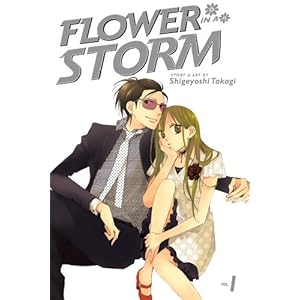
Flowers in a Storm by Shigeyoshi Takagi

Anime? No Volumes of manga: 2
Status: Complete

My rating: Okay

Age range/taboos: Sexual innuendo, some violence, most of it silly. It's probably safe for a teenager who is most likely to be more tolerant of this level of nonsense than I am.

Premise: Our heroine is a high school student with extraordinary physical abilities who tries to pretend she's normal because she thinks her differences preclude her getting a boyfriend. Ironically, she attracts the interest of someone foolishly rich who becomes determined to marry her, using any means necessary and proud as hell of her physical capabilities.

Why It's Just Okay: This could have been very funny, despite the basic stupidity of the notion. Or one of the characters could have been appealing in some way. Instead, our rich suitor is mostly a flaky moron who makes no sense and the heroine's incentive to resist the flaky moron (since she's not exactly a rocket scientist herself) seems weak from the get go. She wants a boyfriend and romance, seems protective of the one guy who is clearly comfortable with her weirdnesses. Since she's not thrown really by his weirdnesses, I don't get the conflict. I read the first one thinking it was stupid but had a couple cute moments. Rereading it when I had the second one changed my mind. My stupid meter was pegged. Also, the artwork didn't appeal to me.

Tail of the Moon by Rinko Ueda

Anime? No Volumes of manga: 15
Status: Complete

My rating: Okay

Age range/taboos: Nudity (but not detailed nudity), near rape, plenty of sexual references, plenty of violence. I think it's rated for older teens. That's probably right, though much of it has a cutesy look and feel.

Premise: Set in the Tensho Era of Japan, Usagi is a failure at becoming a ninja largely because she's lazy. As a last ditch effort, she's sent to a neighboring ninja village to marry the highly competent but uninterested Hanzo. His village is desperate for him to find a bride, but he won't wed anyone and, even when Usagi somehow worms her way into his heart, won't marry her until she becomes a real ninja.

Why It Was Just Okay: Okay, it's a period of history that interests me and there are real events covered in this. And shinobi lore is an interest of mine. There's definitely some good humor in this and some nice moments. However, the things that were wrong were painful in the extreme (noisiest ninjas ever, for instance). Usagi has the mentality of a nine-year-old, even if she has a developed body and looks like a black-haired cherub. The artwork is fine, with particularly the male characters being ridiculously good-looking. They were also, without exception, attracted to Usagi which I just didn't get. Hanzo's focus on appearances is whacked, but not as whacked as Usagi's nominal foolishness which manages to screw up nearly everything she's involved in. But it's all good because she can make a medicine that will cure anything, from nerve damage to blindness with any handy herbs. (The Mother should not read this.) Usagi's immaturity, more than her nominal age, make this seem somewhat creepy. Yes, she's a brave kid who works hard when she has to, but the inexhaustible ingenue-ness wore me down.


Wild Ones (aka Arakure) by Kiyo Fujiwara

Anime? No Volumes of manga: 10
Status:
Complete

My rating: Okay

Age range/taboos: Cross dressing, some very minimal sexual innuendo. More threat of violence than actual violence. Really, it's pretty safe for teenagers, too, the title notwithstanding.

Premise: Orphan (Sachie) is adopted by her grandfather who happens to be the head of a yakuza organization (gangsters) who are effectively harmless. A teenager just a year older is assigned as her bodyguard/caretaker, whose job is complicated by his love for her and her reckless disregard for anything resembling judgement.

Why It Was Just Okay: There's some comic potential in a group of shy good-hearted yakuza (so common in reality) taking care of a single teenaged girl no matter what wrong-headed thing she decides to do. There is something actually charming about the bodyguard's devotion to her. She's certainly good-natured, just heedless. Problem is, this notion would have worked for a few books at most, not dragged out to ten with the two leads (obviously in love in first few chapters) still not understanding the situation in volume 8. Oy! Ten volume romance with one kiss. Pacing was a problem and the same old tired unnecessary adventures started to get old long before I reached the end of them. You'd think Sachie would learn something over time. The artwork was okay, somewhat standard, but there was something freaky about the mirror-like eyes everyone had. The end was both frustrating and lame, in my opinion.

Read more...

MangaMania: Special A/Vampire Game

>> Thursday, March 10, 2011

Contest!
First, something I never ever do, I'm going to do. That's right, a contest! And it's a retroactive contest. See, during my manga mania, I picked up several books that I either already had or turned out didn't work out for me, including several first in a series: Otomen, Kimi ni todoke, Ratsetsu, Bride of the Water God, and Vampire Knight. I also have volume 20 (don't ask me why) of Fruits Basket over and above the whole set and volume 1 of Night of the Beasts, which I let my manga-obsessed toddler play with so I can't vouch for the condition. I figured I'd make a drawing of all those who took the effort to make a comment throughout the whole manga mania series (including those to come) and draw names out of the hat for each commenter. Then they get to pick which book they want (first come, first serve) and I'll send it to them. Five books, five winners (6-7 winners if anyone wants to take a chance on the state of Night of the Beasts or wants Vol 20 of FB). I'll include anyone who's already commented, though you can bow out if you'd like. Most are in good enough condition for regifting if you want to do that. If no one's interested, hey, I'll donate them to the local library.

Special A by Minami Maki

Anime? Yes Volumes of manga: 17
Status:
Complete

My rating: Has a certain appeal

Age range/taboos: Some cross-dressing. Pervasive but non-lethal violence. Pretty safe for teens in my opinion.

Premise: Hikari, the commoner, is rivals with Takashima Kei who is rich, mind-bogglingly brilliant and exceptionally athletic. She isn't the same kind of natural but manages to come up second place through absolute willpower and hard work. Consumed with finally beating him, she's oblivious to the fact he's been desperately in love with her since they were kids. Special A refers to a special class for the most exceptional students in a high end private high school, which is where our protagonists are.

What works: Aside from the ridiculous exaggerations in wealth and abilities, Takashima Kei has my complete sympathy. Having everything easy just means the expectations are ridiculous and the only thing in the world that gives him joy is his interaction with the enthusiastic and well-meaning Hikari. Rather than feeling superior, he's absolutely in awe of her hard work and what she accomplishes without his natural gifts. Since she completely doesn't see romance on the horizon, Kei needs the patience of a saint as he works around her endless misunderstandings and awkward attempts to embrace her feelings.

Hikari is completely innocent, honorable and trusting. She is also quite capable of kicking serious butt, which is always charming in a manga female. It's even pretty easy to see why she's so important to Kei, who would work himself to death if it weren't for her involvement. If she wasn't so unbelievably clueless, she might be quite likable. It is also, quite frequently very humorous, mostly because the richy-rich scenarios and plot-lines are so desperately absurd.

Note: The anime has a certain charm, but it's dubbed (at least what I saw) and sometimes the Japanese originals are a bit grating. But I liked it anyway and watched the whole thing.

What I didn't like: Unfortunately, Hikari is dumb as a post, no matter how well she powers through tests. I admire Kei's patience because she frustrates the ever living hell out of me. The other members of Special A are, in my opinion, relatively hollow characters despite the stories the author's tried to weave around them. The absurdity is frequently humorous, but sometimes it's as wearying as Hikari's immature idiocy.

The artwork doesn't impress me much. I don't find it particularly compelling or polished.

Vampire Game

Anime? No Volumes of manga: 15 Status: Complete

My rating: Has a certain appeal

Age range/taboos: Some sexual (including homosexual) innuendo and violence. Some pretty benign sort of nudity. Cross dressing, too. Still, it's all pretty harmless. I wouldn't be worried if I had a teenager read it.

Premise: Vampire killed in mortal combat with a great hero is reincarnated as a cat set on killing the hero in his reincarnated mode. Instead, he gets mixed up in the convoluted shenanigans surrounding, Ishtar the young and headstrong princess (and descendant of the original hero) and her many suitors.

What works: It's hard not to like both the reincarnated vampire and Ishtar. Although she starts out looking sort of like a care-for-nobody, one soon sees past that and, although the adventures spawned are (surprise!) absurd, they are original and creative. Darres, who Ishtar loves, is somewhat oblivious, but he is devoted and capable (mostly). If wrong-headed and heedless, Ishtar is somewhat capable as well, which is nice. The vampire (whose powers increase and include shapeshifting) is amazingly useful and grows to be very appealing.

There are a host of side characters that end up being quite compelling with little fanfare. I think part of that is that the artwork is appealing and pretty consistent. My daughter loves this one more than I do, but I have to say it was a fun read. And, sometimes, that's all you need.
What I didn't like: I wish Darres wasn't quite so clueless. I would have liked him to be a bit more involved in Ishtar's obvious romance.

Read more...

MangaMania: Millenium Snow/Phantom Dream

>> Wednesday, March 9, 2011

Contest!
First, something I never ever do, I'm going to do. That's right, a contest! And it's a retroactive contest. See, during my manga mania, I picked up several books that I either already had or turned out didn't work out for me, including several first in a series: Otomen, Kimi ni todoke, Ratsetsu, Bride of the Water God, and Vampire Knight. I also have volume 20 (don't ask me why) of Fruits Basket over and above the whole set and volume 1 of Night of the Beasts, which I let my manga-obsessed toddler play with so I can't vouch for the condition. I figured I'd make a drawing of all those who took the effort to make a comment throughout the whole manga mania series (including those to come) and draw names out of the hat for each commenter. Then they get to pick which book they want (first come, first serve) and I'll send it to them. Five books, five winners (6-7 winners if anyone wants to take a chance on the state of Night of the Beasts or wants Vol 20 of FB). I'll include anyone who's already commented, though you can bow out if you'd like. Most are in good enough condition for regifting if you want to do that. If no one's interested, hey, I'll donate them to the local library.

Millenium Snow

Millenium Snow, a two volume manga written by Bisco Hatori (of OHSHC fame).

Anime? No Volumes of manga: 2 Status: Complete

My rating: Has a certain appeal

Age range/taboos: Mostly your normal blood-drinking taboos inherent to anything involving vampires. Really, nothing else comes to mind. I can't see a teenager taking harm from reading this.

Premise: Our heroine, Chiyuki, whose full name means "thousand snows" has a medical condition that has largely kept her in the hospital her whole life and is expected to kill her soon, if not any moment. She sees someone leap from a roof and leaves her hospital bed to find Toya, a vampire with the power to keep a human alive for a thousand years but no inclination to do so or live that long himself. He won't drink blood and so lives on excessive amounts of food instead.

What works: The premise largely works because she wants to live and he, he really has no interest in living. It is his belief that drinking her blood (lifelong) to prolong her life (and apparently it's a step that cannot be undone) would make her miserable and that she would blame him for living too damn long. Apparently, finding a single companion is standard practice for vampires, which works symbiotically for both and precludes that standard blood-drinking rampages. I think that's kind of clever and, at least, a little off the beaten track. It's just twisted enough to appeal.

I actually like both characters even if they are somewhat stiltingly portrayed and Toya spends the first half of the first book largely unlikeable. Toya's minion, the bat, however is quite likeable and the largely selfless and life-loving Chiyuki is appealing. I like that he ends up prolonging her life (and curing her) with a little of his own blood. There is some worthwhile humor as well, though the characters are often quite dense as well. Chiyuki is probably the most appealing of the protagonists because she knows what she wants and she's perfectly patient about getting it. Personality-wise, she's the strongest, which is a nice change. I like that he worries that he loves her too much to be trusted to stay with her.

What I didn't like: I don't like the artwork at all. It's busy, confusing and the characters are drawn in a very unappealing way, despite the descriptions of being "handsome" and the like. Too much shouting going on and the wedge between the two, Toya's reluctance to solve both their problems at once, seems contrived and lasts too long. But the biggest thing I disliked was that the author obviously intended to carry it further and was stopped so it ends feeling very unfinished with no resolution. Irritating in the extreme to me.

Phantom Dream by Natsuki Takaya (who did Fruits Basket)

Anime? No Volumes of manga: 5 Status: Complete

My rating: Has a certain appeal

Age range/taboos: Nudity, teenage sex (though implied more than shown), violence. Older teen is probably most appropriate.

Premise: Summoner who protects humankind from demons intent on turning the world to chaos and eradicating humankind (heavy, I know) is in love with a "normal" girl who turns out to be pivotal to the whole thing.

What works: I've mentioned that mythological stuff appeals to me so this does too. This is also some of my favorite artwork by Takaya which isn't as emotionally impactful as Fruits Basket but is more elaborate and expansive than Tsubasa.

In this case, although I like the main male protagonist well enough, it's the girl I like best, Asahi, who is considered too normal to be a real bride. Her devotion and self-sacrifice for Tamaki is compelling and absolute. That there's more than meets the eye adds something to it all. It's interesting and has dark elements that many manga don't have. I like that. It had a satisfying ending.

What I didn't like: I don't really get Tamaki so much. He doesn't seem terribly bright. Much of the mystique and notions behind the fight between good and bad is confusing and we spend a long time wondering what side Asahi is on. Some of the translation seems stilted and the motivations are confusing.

Read more...

MangaMania: Bride of the Water God/Butterflies, Flowers

>> Tuesday, March 8, 2011

Contest!
First, something I never ever do, I'm going to do. That's right, a contest! And it's a retroactive contest. See, during my manga mania, I picked up several books that I either already had or turned out didn't work out for me, including several first in a series: Otomen, Kimi ni todoke, Ratsetsu, Bride of the Water God, and Vampire Knight. I also have volume 20 (don't ask me why) of Fruits Basket over and above the whole set and volume 1 of Night of the Beasts, which I let my manga-obsessed toddler play with so I can't vouch for the condition. I figured I'd make a drawing of all those who took the effort to make a comment throughout the whole manga mania series (including those to come) and draw names out of the hat for each commenter. Then they get to pick which book they want (first come, first serve) and I'll send it to them. Five books, five winners (6-7 winners if anyone wants to take a chance on the state of Night of the Beasts or wants Vol 20 of FB). I'll include anyone who's already commented, though you can bow out if you'd like. Most are in good enough condition for regifting if you want to do that. If no one's interested, hey, I'll donate them to the local library.

Bride of the Water God

Bride of the Water God is technically a manwha from Korea, written by Yun Mi-kyung. It's also unique in all these series I describe in that it reads front to back and left to right like a "normal" comic.

Anime? No Volumes of manga: 11 (7 Eng) Status: Ongoing

My rating: Has a certain appeal

Age range/taboos: Some limited sexual innuendo and violence, though more the description of violence than actual. Again, I don't see teenagers coming to grief reading this, though I'm not sure how much it would appeal to them either (though my daughter likes it).

Premise: Based on myths about the water god Habaek, it largely follows the intrigue of the gods' realm with everyone wanting to control Habaek who is hung up, first on his memories of his lost human bride (Nakbin) and then on his new human bride Soah (sacrificed by the village to end a drought). Soah is who we follow. Soah is confused since Habaek is cursed to be a child during during the day and a man by night since the man (who "isn't" Habaek) romances her.

What works: Of all the manga-ish books I have, this is the series where artwork was the biggest driver. It's beautiful, detailed, powerful, filled with decorative intricacies and convoluted costumes. I'm not lying when I say it's stunning and the colored cover art is gorgeous, too.

I also like mythology and like learning more about it, so it's somewhat interesting to me from that point. I have some fondness for Mui, even if I don't understand his motivations frequently, I understand those moments when he is trying to be protective, even if it comes across more like callous given that his interest in Soah makes her attractive as a pawn in the gods' power struggle.

What I didn't like: It's frustrating to me that Soah doesn't get most of what's going on. She seems to have a very limited understanding. Pretty, clearly attached to Habaek (in both forms) and jealous of the many Nakbin spinoffs that show up, but still largely clueless and easily used. She's not particularly strong.

Also the story is confusing, partially because of the large pantheon of characters I, personally, have a hard time keeping up with (especially the Emporer and his tendency for disguise), partially because many characters have multiple names, and partially because I find the story itself hard to follow. My lack of understanding of the actual myths behind the story probably don't help much. It also seems to drag on a bit so pacing's slow, possibly because the artist behind this takes up so many pages with dramatic art. So it's not all bad.

Butterflies, Flowers

Talk about a contrast to Bride of the Water God, Butterflies, Flowers is a mature-rated manga written by Yuki Yoshihara, with adults in a "office" setting and a great deal of melodrama.

Anime? No Volumes of manga: 8 (6 Eng) Status: Complete

My rating: Has a certain appeal

Age range/taboos: It's rated mature which might be a misnomer, not because I recommend it for teenagers (I don't) but because it's not exactly designed to appeal to the mature. Adults only, but it's more fraternity-type maturity. There are few sexual taboos that aren't crossed here, with plenty of innuendo, nudity and sex, some measure of violence. Cross-dressing is included.

Premise: Working girl whose wealthy family has fallen on hard times find she's working for a man who was once her special servant growing up. His adoration of her as a child becomes something more adult but not without confounding them both. He's also very very weird.

What works: I'm struggling a bit with this one. The characters, for once, are not the draw. I don't really like either one, though I like Suwo a bit. In fact, a number of side characters are a good bit of fun. Perhaps I like the fact that nothing is sacred, that a good bit of this is making fun of the manga excesses only a good bit more crudely than OHSHC did. Domoto, our male lead, is one of the most melodramatic characters ever, possibly schizophrenic. He is both calm and cool and hot-tempered, a sexual harasser of the highest order and abjectly correct in preserving his girlfriend's virtue, emotionally emotive to the nth degree (he cries frequently). The action and plotlines are consistently absurd.

And that, boys and girls, might be why I've read this raunchy silly thing more than once, why it still makes me laugh. You can't take the damn thing too seriously and it's so stupid it's funny. True, that can backfire and I know a number of things that peg out my stupid meter so that my laughter reflex is squashed. Apparently this just wiggles under that for me. When we go off on "otaku" tangents (otaku means fans of manga/anime/video games) where our characters can drive a mechanized suit a la gundam, it's ridiculous. And, I guess, that it's charm.

What I didn't like: Well, it's stupid. The characters aren't particularly likeable or do anything that makes a lick of sense. The artwork is not good, in my opinion, nor our main players good looking.

Some of the sexual harassment, sexual aggression, etc. is off-putting. I find that's true of most sophomoric romps like this, though. One could argue a serious level of misogyny here, but I don't think that's entirely accurate. The girl is often in charge of the situation and still, largely, calls the shots. And Domoto swings from workplace aggressor to happy housewife.

Read more...

MangaMania: Backstage Prince/Beast Master

>> Monday, March 7, 2011

Contest!
First, something I never ever do, I'm going to do. That's right, a contest! And it's a retroactive contest. See, during my manga mania, I picked up several books that I either already had or turned out didn't work out for me, including several first in a series: Otomen, Kimi ni todoke, Ratsetsu, Bride of the Water God, and Vampire Knight. I also have volume 20 (don't ask me why) of Fruits Basket over and above the whole set and volume 1 of Night of the Beasts, which I let my manga-obsessed toddler play with so I can't vouch for the condition. I figured I'd make a drawing of all those who took the effort to make a comment throughout the whole manga mania series (including those to come) and draw names out of the hat for each commenter. Then they get to pick which book they want (first come, first serve) and I'll send it to them. Five books, five winners (6-7 winners if anyone wants to take a chance on the state of Night of the Beasts or wants Vol 20 of FB). I'll include anyone who's already commented, though you can bow out if you'd like. Most are in good enough condition for regifting if you want to do that. If no one's interested, hey, I'll donate them to the local library.

Alright, moving on to series I liked but don't necessarily get down and reread over and over and over and over again. Ones that appealed to me for some reason or another, enough that I own all of them, too (or am getting all of them), but can't necessarily overlook their flaws. They often have either partially developed characters or only one character I really like. Four of them are earlier works by mangaku (manga authors) whose later works made my "gotta have 'em all" list.

Backstage Prince

First, here's Backstage Prince, a two volume to completion manga written by Kanako Sakurakoji (who also wrote Black Bird), in which we see the author favors a particular look for her protagonists, quite similar to those in Black Bird. We also discover that she's in love with a kabuki actor. Wikipedia has a really interesting article on Kubuki for those interested. But I digress.

Anime? No Volumes of manga: 2
Status: Complete

My rating: Has a certain appeal

Age range/taboos: I don't see an issue with any teenager reading this. No nudity, minimal lewdness. Cross-dressing is limited to the actual Kabuki.

Premise: "Normal" high school student, Akari, signs up to assist a talented up and coming kabuki actor after she accidentally hurts him. Although handsome and talented, the actor is a misanthrope and generally hates people, but she (and his cat) become exceptions to the world he mostly scorns. Her influence and support enable him to largely overcome his bad attitude sufficiently that it doesn't undermine his success.

What works: The cat is charming. I actually like our misanthrope who doesn't hate people so much as he is somewhat painfully shy and has been unwillingly in the spotlight since birth. He's been under the control of others entirely and his relationship with Akari is one of the first things he takes a stand on. He's not a people person and he, as a person, is unable or unwilling to compete with the image others have of him. Akari, who cares nothing about his image and sees him for himself, is the first person he sees as seeing him as he is. His ego is confined to his kabuki skills which are, apparently, prodigious.

His whole-hearted and unwavering devotion to the two things he cares about: the cat and Akari, is touching and sweet, even if he's not the best at expressing it. So, yeah, I liked him, even though we only saw him through Akari's eyes. I also liked their relationship, how she brought out the best in him just by being there.

To be honest, I thought the insight into Kabuki was also interesting, since I knew nothing about it. Cool beans. It's also a nice short read, but ending tidily.

What I didn't like: The characters aren't entirely fleshed out and it's a bit heavy on the teenage angst, given the assistant is a teenager. She's supportive but really doesn't do much of anything. She's sort of reactive, so she's not as strong as I would have liked. Still, she ends up as stalwart as her two-years senior boyfriend. The artwork is not particularly refined or notable.

Beast Master

I know, right? Some of the names . . . oh well, part of it is likely translation. Beast Master is another earlier work by a mangaku I like, this time Kyousuke Motomi (author of Dengeki Daisy). I might have actually bumped this into gotta have 'em all except I just finished writing those up when I read this one. It's still too new for me to be objective. So, be warned, it might move up the ladder (or conceivably, down).

Anime? No Volumes of manga: 2
Status:
Complete

My rating: Has a certain appeal

Age range/taboos: Our hero here, spent much of his life "in the wild" and will go on a violent berserk rampage if put at risk and/or bloodied (or, apparently, if his girlfriend is). So, yeah, bloody violence happens but no corpses except for a leopard. Still, I don't think many teenagers would be adversely affected by this.

Premise: Girl who loves animals but sends them running with her smothery ways befriends a boy who comes off as scary while being exceptionally good with animals. Turns out, he's lived in the wild most of his life. She discovers quickly that he will go berserk to protect himself, but that she can get him to calm down when no one else can.

What works: Both protagonists are appealing, "Leo" (the "wild boy") is unaffected and unstintingly affectionate with his own backward charm that I like. She is selfless and strong, without being overpowering or nasty. If she's a little slow to catch on to Leo's devotion to her, that's hardly anything new in manga. I like that she refuses to treat him like an animal and that both of them are focused on the well-being of the other. This manga could have been longer and still appealing, but it shortness kept it from bogging down, so that's nice, too. Tidy.

I like the emphasis on animals (the girl's father is a veterinarian) and find Leo's gentleness (when not in berserk mode) completely in character. I like his unfamiliarity with modern technology and processed foods fun, too. The artwork, like Backstage Prince was, is less refined than the author's later works, but still capable of being quite moving. This is more dramatic and emotionally pulling than Backstage Prince. I also have to admit I liked both of the short mini-manga stories included with the books.

What I didn't like: Side characters pretty much sucked (except for Banchou, the friendly neighborhood thug). Either they were shallow and uninteresting, or too wacked to take seriously. The back story behind Leo's unconventional upbringing was also pretty weak, even by manga standards. Fortunately, it wasn't really key except toward the end.

Read more...

MangaMania Observations 2

>> Sunday, March 6, 2011

Last time, I talked about observations and trends I saw in artwork, idiosyncrasies and stylistic choices that might throw off a new reader but also, in my opinion, could enhance humor and add creative depth.

But there are either cultural or other idiosyncrasies that might be difficult for many of us US folks to work around. Some obviously stem from cultural differences between Japan and here (which is far less repressed in some ways and more repressed in others). Some stem from the differences in the way education is run, the emphasis on education and even the relative lack of widespread crime in Japan. For instance, apparently Japanese school children routinely make their way to their schools alone, taking trains or buses as required without fanfare. I would presume you could do the same thing in European cities where mass transit is pervasive and crime is a much lower level than it is here, where here is seems callous or dangerous. Also, apparently, children pay tuition for (at least) high school with tuition varying widely and, sometimes, scholarships offered to excellent students.

Some have to do with how characters are portrayed and what, in Japanese culture, is most admired. Given that I haven't lived in Japan, I have to speculate what are aspects particularly to manga (as opposed to Japanese life) and what are reflections on actuality. Still here are some trends I've noticed in the manga with no intimated assertion on how it is in reality.

  • Student council is a much bigger deal in Shojo high schools than it ever was in my high school, with student councils expected to help police the school and support clubs and activities. Regular students are supposed to help clean up classrooms and take out recycling, etc. as well. High schools are three year institutions. Taking exams to get into university is a huge deal and is the focal point for anyone wanting to move forward academically.
  • Being academically advanced has considerable cache, with popularity often going with it, particularly for male characters (not sure why it's different for women, but, hell, here in the US being bright isn't really popular for either gender so it could be worse). Those that also excel in sports have to just about beat off women with sticks. As always, being rich doesn't hurt either, but smart still wins. Girls are rarely at the top academically and, if girls are struggling with one or more subjects, it's likely math and/or English.
  • Fever is the ultimate default illness. Skull fracture, separated shoulder - you'll recover readily. You aren't really incapacitated until you get a fever, but a fever alone (whether brought on by an aggravated cold or stress or overwork or exhaustion) will cause collapse and can only really be treated with bedrest (often just overnight).
  • Girls are expected to be more romantically aggressive, with Valentines all about giving boys you admire chocolate and girls unlikely to receive any but friendship chocolate from other female friends. In shojo manga, girls are frequently confessing their feelings to boys who may or may not have paid them the slightest attention (though, for some reason, it is a rarity for a central female protagonist to do so). Girl fandom, as noted in these manga, is almost frightening, with popular boys seen as nearly rock stars.
  • Costume play (cosplay) seems to be quite popular with little or no stigma attached to cross-dressing, especially for guys. This openmindedness often is extended outward to homosexuality as well, with for some reason male homosexuality being generally accepted with perhaps more ease (if not titillation particularly among girls) than lesbianism. Not sure I entirely get that.
  • Girls are not restricted to typical girl roles/professions; nor are men. In half of the manga I've read, girls are excellent cooks, for instance, while in the other half either they've been pampered and never learned or they are inherently unable to cook no matter how hard they try (including the potential for explosions). In the latter cases, where girls can't cook, the men invariably are quite adept at cooking if not exceptionally gifted chefs. I guess there's something to be said that a lasting relationship requires that at least one of the members can cook. It is endearing that men attracted to even the worst cooks will still willingly eat what's cooked for them. Gitls in these manga strive to be everything from restaurateurs to teachers to lawyers to what have you. Boys also seem to be willing to pursue teaching and nursing careers rather than just glamorous or flashy professions.
  • Physical aggression is portrayed quite differently, with physical attacks being quite frequent (and even friendly), particularly between boys, between girls and from girls to boys (not, except for bad guys, generally from males toward girls). Girls, in shojo manga, are frequently physically capable and aggressive, generally well able to defend themselves. This capability does not, however, preclude their love interests from rushing to their defense or otherwise trying to protect them with or without their permission. Some girls take that better than others. Some will do the same right back, often to the boy's consternation. Girls unable to do their own defending will often have other skills that still enable them to hold their own (like Misao's ability to heal demons and her willingness to use venom).
  • The moral high ground is more likely to be the girl's thing. Girls are routinely jumping into danger in the interest of protecting others or standing up for some principle or the other, whereas the males are more likely just to jump in if someone specific they care about is involved. The vast majority of shojo manga girls are intrepid, sometimes even frighteningly so, even if they get panicked when things spiral away. Still, they almost all have their moments where they are doing the rescuing.
  • Kissing is a bigger deal than it is here, I think. High school students can be in relationships for months without kissing apparently. Kissing is generally described something you only do with someone you love (which is apparently not necessarily true with sex). And that goes to something else that is almost always true: even the most passionate male protagonist backs off and takes his cues from the girl. That includes stepping aside gracefully if the girl chooses someone else (as happens in a number of the love triangles). It is undoubtedly one reason I like these mangas.
  • Shojo manga romance is almost always the kind of romance I like, where the interests and happiness of who you love takes precedence over oneself, including one's own passion. I wish western romance would embrace that kind of thinking again.
Well, that was fun. I'm sure I missed some but, hey, you get the idea.

Read more...

MangaMania Observations 1

>> Thursday, March 3, 2011

Well, an interesting experiment. Somehow, talking about manga seems to have driven off my few remaining readers. Odd. Well, that's hardly surprising. Ever since I was young, I devoured books, good and bad, picking them apart so I understood why I liked them, what moved me, what left me cold so I could emulate the one and avoid the other.

Truthfully, I was as surprised as you all appear to be that I have so thoroughly enjoyed manga, since I think I had a rather dismissive attitude in the beginning. Please, comic books? Ah, but now I'm so grateful I really tried to accept and understand. If I hadn't, I would have missed out on a whole new world of experiences, clarifications and variations on character types I love, a sizable amount of laughter. And, if it's bothered you all that I've "wasted my time" waxing on and on about manga, it hasn't been a waste to me. Expressing what I loved and even didn't love helped me understand it better, just like analyzing a novel. And I've enjoyed reliving piences of the manga.

So–insert groans here–I'll be doing more of the same, this time describing manga that didn't make my top rating and even, eventually, those I actively disliked and why. Before I do, however, I'd like to go over a few observations from manga that I thought were interesting and perhaps even challenging for someone unfamiliar with the world of manga.

Mechanics and appearance:

  • First, a large percentage of Japanese origin manga read differently than we US folks are used to. They read "back to front", generally right to left and top to bottom. I say generally because manga don't always keep their drawings in tidy rectangular boxes and almost never in uniform sizes. Angled, even curved areas, whole page and even two page presentations, tiny boxes focusing on a small aspect of a bigger picture might be superimposed on another panel. Thoughts and discussion also might go from one box to the other, making following the "action" and thought/dialogues can take a bit of practice. The inconvenience of learning a new way to read "comics" is more than made up for in the creativity that results, where the shape and configuration of the drawings enhance the impact of the drawings. Way cool.
  • Secondly, the caliber and style of drawings vary widely, not only manga to manga, but within a manga. Lush detailed drawings with textures and shading and elaborate costumes and backdrops might be juxtaposed to line drawings to show emotion next to simplified drawings (even stick figures) that emphasize mood, attitude or position. Some use many gradations between these levels, like Minami (Special A). This also can take some getting used to. Some authors, Hino (Vampire Knight) have very limited reliance on the simplified drawings but do considerable work with the line vs detailed drawings. Manhwa artist Mi-kyung (Bride of the Water God) tends to keep everything at a high level. Hatori (Ouran High School Host Club) runs the full gamut, often mixing the stylized/simplified with the detailed almost willy nilly, including stick figures. Some mangaku make the absolute most of their simplified drawings, making them the punchline or adding visual hilarity with manga exaggerations for a slapstick element.
  • Manga tends to incorporate a great many exaggerated mannerisms. Olympic level weeping, excessive shock, rage, befuddlement, embarrassment and even violence (and reaction to violence, such as overblown bumps on the head) abound. This symbol, ╬, for instance, is frequently used to indicate irritation, even rage (like a vein throbbing). Bigger and bolder (or more of them) indicate the level. Blushing/fever might be full faced and physically sizzling. Tears can leap out from the face, flow in unending rivulets down the face or even form pools of water. A new reader, unused to such stylistic eccentricities, could readily be confounded by them, but, with patience, one can see that they only serve to communicate something simply and easily without slowing things down. They can also be hilarious.

  • Dialog can be confusing, with different shapes for shouting (pointing) or happy things (cloudlike) mixed with thoughts and internal dialogue and talk bubbles, often ambiguously attributed, especially if the conversation involves a large group (as happens in Fruits Basket and OHSHC). In many cases, differentiation might include a symbol within that box to denote speaker (like one of the zodiac animals or a ricecake for Tohru in Fruits Basket or the glasses for Kyoya in OHSHC). Or a particular font or style might be used, like Huninozuka's flowers all over his comments. Like most manga tendencies, following dialog and various trains of thought over diverse panels and through complex relationships gets easier with practice.
  • Sound effects and action effects. Yeah, I know, sound effects? Well, some I can see: crash, bam, clatter, zap, etc. And I can understand some actions that aren't quite obvious ("moves hair," "fingersnap," and the like), but they often include the sounds of footsteps and heartbeats. The words used to describe them often change; for heartbeat, I've seen: b-bump, b-dump, dokin, thathump. And why do I need to have footsteps? These special effects are often part of the drawing in kanji, which is sometimes translated in the English versions and sometimes left as is without explanation. (Ironically, with the volunteer translations, they seem to translate the effects the official versions don't - and vice versa.)
Wow, that was more than I expected. I guess I'll have to go over the stereotypes and other weirdnesses next time.

Read more...

MangaMania: Vampire Knight

>> Wednesday, March 2, 2011

Vampire Knight by Matsuri Hino is the last of my Christmas manga experiments to become a "gotta have 'em all" manga, though it's straddling the line between "gotta have 'em all" and "Compelling but not a favorite." To date, though, I tend to own them all whether they fit in either category. If I have the urge to read a series more than once, I buy them all and that applies to Vampire Knight, though it is far different in tone, style and story than the majority I own.

Despite how "in" vampires are (and my fondness for the Twilight series), I am not a vampire type person. I've never understood the fascination with vampires in general and don't go out of my way to read vampiric stories. What I like are good characters and any scenario (fantasy/science fiction) that builds a world that makes sense within its own framework. If characters appeal to me, I'm pretty lax on that second part, too. If a vampire story happens to do this, create appealing character(s) or a world that intrigues, I'll read it. For those bothered by Twilight, at least these vampires don't sparkle.

When I read the first one, I was on the fence on whether I wanted to pursue it. Then my daughter had me watch the first few episodes of anime and, rereading it, I became more and more intrigued by Kaname's character and the world-building regarding vampires/vampire hunters (genetic, by the way), and humans.

Anime? Yes Volumes of manga: 13 (11 Eng) Status: Ongoing

My rating: Gotta have 'em all (barely)

Age range: It's listed for older teen and should be (16+), primarily (I think) for some pretty grisly violence and no shortage of blood and death. Although there is no nudity or direct allusions to sex, much of the bloodletting is distinctly sensual.

Taboos and "warnings": Lots of bloody and graphic violence and horrific deaths. A great deal of veiled and unveiled sensuality. The vampires have their own rules, which also encompass incest and enslavement. Some hints at homosexuality and masochism, but nothing too overt.

Premise: Cross Academy has a day class (human) and a night class (vampires, actively working on measures to reduce friction between humans and vampires). The vampires are led by one of the last remaining pureblood vampires, Kaname, who saved the heroine, Yuki, from a vampire when she was five years old and who maintains a sincere and protective attachment to her. Yuki and Zero are both adoptees of the Academy headmaster, are the only ones who know the true nature of the night class, and are tasked with keeping the day and night classes separate. This is further complicated with Zero's antipathy toward vampires (as his family of vampire hunters were killed by one) while he slowly turns into a vampire thanks to a pureblood's bite.

Common manga themes: Self-restraint is romantic?

What works: First, at center stage, is the artwork. Very gothic, with gorgeous "uniforms" and very evocative imagery, I'd be lying if I told you that the artwork wasn't a big part of the appeal. Kaname is particularly beautiful, while Zero is drawn for beauty that seems somehow more down-to-earth, edgy. I found the artwork for the various girls and female characters far less compelling, but I tended to find their personalities the same way, so that might be related.

Secondly, I did appreciate the depth and complexity of this secondary world, with its long and bloody history, of vampires, vampire hunters and humans. It's not without flaw or contradiction and, in many ways, it seems amoral, but it has its poignancy and true emotion as well. A great many ins and outs and subtleties play through it and it's rather fascinating to follow them around to find out yet another secret. Actually, as more is revealed, more becomes tidy and holds together with the big linchpin to the whole thing being Kaname, not the youthful Kaname Kuran everyone thinks he is but the endlessly old Kaname who was as much a factor in the decline of vampires' ascendency as he was the creation of the vampire hunters.

I like how blood is a metaphor for so many things. It is used not only to transfer thoughts and emotions, and memories, but also love (a vampire's thirst can only be quenched by the blood of the one they love), longevity, medicine, nutrition, mutagent, control, power (including specific vampire powers) and even directly as a weapon, as used by Kaname, his "father," his "uncle" and also Senri Shiki. Blood is also used to seal spells, particularly the one that makes a vampire "human" and erases the memory of their former lives. I like that vampires frequently drink each other's blood as opposed to just preying on humans. There is also a modicum of humor, though it's more a sidelight rather than pervasive.

Kaname is another big draw. Beautifully and poignantly drawn, he is a man of mysteries, with his overt protective adoration of Yuki contrasting with some pretty dark doings involving considerable violence. Coupled with an otherworldly control (all but unheard of among vampires) is a rather amoral willingness to use people to serve his purposes. To all outward appearances, he is far more humane and well-intentioned than most of his ilk, and yet . . . Those loyal to him are fiercely so, including both Yuki and the Cross Academy headmaster. I find the characters of a number of the night class students appealing, even though we only get tantalizing glimpses.

Zero also is fascinating, the ultimate conflicted individual, hating vampires passionately, yet unable to preclude his own vampire nature from manifesting. Yuki's devotion keeps him from being torn apart by these conflicting drives (at the cost of her own blood), while both the vampires and the vampires hunters use him mercilessly to suit themselves. Yet, being used, he has considerable will and ends up using those that use him to serve his own purposes. His love for Yuki is touching and tragic. I suspect one reason why this manga continued past the "end" was a sizeable faction of fans who want to see Zero get the girl (as my daughter does).

Favorite character: Duh. Kaname. I like Zero, but Kaname's absolute devotion to Yuki, not just her person but her happiness, won me over and his complex history and ever-sad eyes are fascinating in the extreme.

Quotes:

Zero: Drinking blood on campus is strictly forbidden. Did you lose your mind, drunk on the scent of blood, vampire?

Zero: I couldn't stop myself from devouring you. I may kill the next human I target as my prey. Shoot me. You're afraid of me, aren't you? Hold the gun with both hands and aim straight. Aim for the center. It's not a crime to kill a vampire.
Yuki: I didn't understand anything but I've lived with you for four years. I'm not afraid. I can stop you. If that time comes. If you want me to stop you, I will stop you.

Yagari: The pureblood vampire holds her so gently in his arms... I don't give a damn why you treat that little girl so differently but of course you realize what she's done. You must be seething with rage, right? Yet you won't do anything, just like a proper honor student. Why is that? Why won't you tear Zero to shreds?
Yuki: It's so that I won't lose my girl.

Kaname: By the way, I've never told you why I'm pretending not to notice what has happened to you. I know how precarious the peace is here at Cross Academy so I thought about who could act as Yuki's shield in this place. You will not double-cross her because you owe her that much. That is why I'm allowing you to live.

Kaname: I cannot have you die now. I've allowed you to live so you could serve Yuki. I know you won't betray her--
Zero: You're assuming things as usual...
Kaname: Oh, but I know because our feelings for Yuki are probably the same.
Zero: I...I only want Yuki to smile from the bottom of her heart.
Kaname: Me too.
Zero: I don't want her to sacrifice herself!
Kaname: Exactly. (He offers his own blood to Zero) Don't ever forget for whom this blood was offered, Zero. No one hates vampires more than you yet you need blood more than any vampire. I think you're the most vampirelike of us all.

Kaname: Yuki, get out of the way. I cannot forgive the man who aimed that gun at you, a weapon that could destroy you, even if it was for a mere moment. I will not forgive him even if you hate me for five hundred or a thousand years.
Yuki: Please, I don't want to make you say something so sad.
Kaname: All right take some time to say goodbye to him. [Sucker]
What I didn't like: Yuki. She's not the worst romantic lead out there for me, but I couldn't get behind her thinking for most of the series. I respect her fierce loyalty, her absolute lack of fear when it comes to death, and even some decisions she made, but she's largely clueless on what's going on around her. She jumps into the fray even when its abysmally stupid to do so and seems to have no consideration for the many people consumed with keeping her safe. I can respect that the "men" who love her do so unstintingly and without reservation (as, admittedly, she does them), but I still do a lot of eye-rolling. I'd be happier if she were just a bit less clueless or inept.

Also, I'm disturbed by the pacing. The story went along quite bracingly for the first ten volumes and had what seemed like a nice tidy ending at the end of volume 10 (48 chapters), what's frequently referred to as the first arc. At the end of that story, the world order as it was is no more, with the Academy's night class a thing of the past, and most of the vampire world turned upside down. The distinction between arcs is so significant and the ending for the first arc so pat that I actually think she'd intended to end it there and was pushed into carrying it forward by rabid fans or publishing dictates.

I'll admit I don't entirely get what's going on in the second arc, but the pacing is considerably slower, with nothing coming to resolution (so far, with 21 more chapters) and some things I can't fathom, like the current relationship with Kaname and Yuki, which should look like marriage but is apparently something else? The style of drawing has changed as well, with it now dominated by a sort of wispy pencil type minimalist drawing and every vampire having the same somewhat empty eyes. Still pretty artwork, but nowhere near as powerful and with minimal contrast between the extensive details and the minimalist.

Vampire Knights has eleven books out in English and chapters available out to at least Chapter 69 as volunteer scans on-line. The anime is dubbed in English, at least for the first arc and the second season is coming out as well. Zero's voice in that is the melodious Vic Mignogna (same as OHSHC's Tamaki). As always, if you love it, buy the books. And, yes, I did..

Read more...

Manga Mania!

>> Tuesday, February 22, 2011

I admit it. I'm obsessed. I took off Friday so I could have a four day weekend and, aside from hanging with the hubby and the two small children, I spent it all immersed in new manga. That's right, I had a terrific time with it and fell in love with two more series.

Sorry for those of you who wanted to see me around, but I don't really regret it. I love getting immersed or falling in love with new characters.

I love it. I haven't entirely figured out why I love it, but I do. I'm going to add a column to the blog on the side with a list of my favorite manga series and, given that I'm between novels at the moment until I get inspired (and because manga is behind my drawing interest at the moment, too), I thought I'd introduce some of my favorites and why in this blog.

Because, hey, the better I understand why I like them, the better I might be able to harness what appeals to improve my own work, assuming it's not all the art.

So, next time, that's what I'll do.

Before I go, some important caveats:

(1) I read mostly shoujo manga, intended for teenage girls, so it's not all encompassing.
(2) Plot, the mangas I've read have such laughably stupid stupid plots and motivations that make no sense - of course, I always felt that way about hero comic books, too, so that might just be me.
(3) social mores and priorities are not the same world-wide.

So, as I go into the mangas, I'll start with my favorites I've found so far. For those of you who'd rather stab yourself in a the eye with a sharp stick than read manga, well, feel free to skip 'em.

Read more...

Not a Salesperson

>> Saturday, February 5, 2011

For those of you wondering what I'm up to, well, I've been going over the Bete novels again. I'm going to try to find an agent and/or publisher for them.

Only problem is, I can't seem to write a query to save my life. Or rather, I can't write a good query to save my life. I mean it seems like a good query when I'm writing it, but the more I read it, the more I have others read it, the more and more it seems "meh."

I read Query Shark religiously. I know intellectually what needs to go in it, but I also know the voice is the key. I can get voice is a hopeless mishmash that confuses and dazes. I can get the formula though it reads as dry as a Pentagon briefing. Despite my best intentions, my queries stink to high heaven.

My husband says I'm not a salesman. He does not mistake the case. I'm the sort of salesperson who could keep people from buying what they came to get. I stink. Part of it is that they are books about characters with the plot largely incidental, so the formula is less than effective. The characters are the selling points, in my opinion.

I also don't do lots of other things that engenders getting published. My first paragraphs are not stellar - I grew up reading classics where you might not even meet the main characters until a third of the way through the book, where character development was everything. It's what I like, but also, apparently, passe. It's not how you get noticed.

Perhaps, and it's a real possibility, my writing isn't really notably better than my sales pitch. Hard to be objective. Perhaps I'll never be published because I can't promote my work properly, even if it is good. Sobering thought, that. But plausible.

Also the drawing has taken a step back, partially because of a crowded work schedule recently and partially because stepping out with new poses and Tander's features didn't work so well. I'll have to go back and regroup and try again.

And I will. I may end up 83 years old and unpublished, but it won't be because I gave up.

But a couple of the days in between are bound to be disheartening.

Read more...

Labels

Blog Makeover by LadyJava Creations